Workshop
Design workshop: plug and play for decentral renewable fuel production facilities
Collaboration between Smart Delta Resources and Platform Renewable Fuels
Background
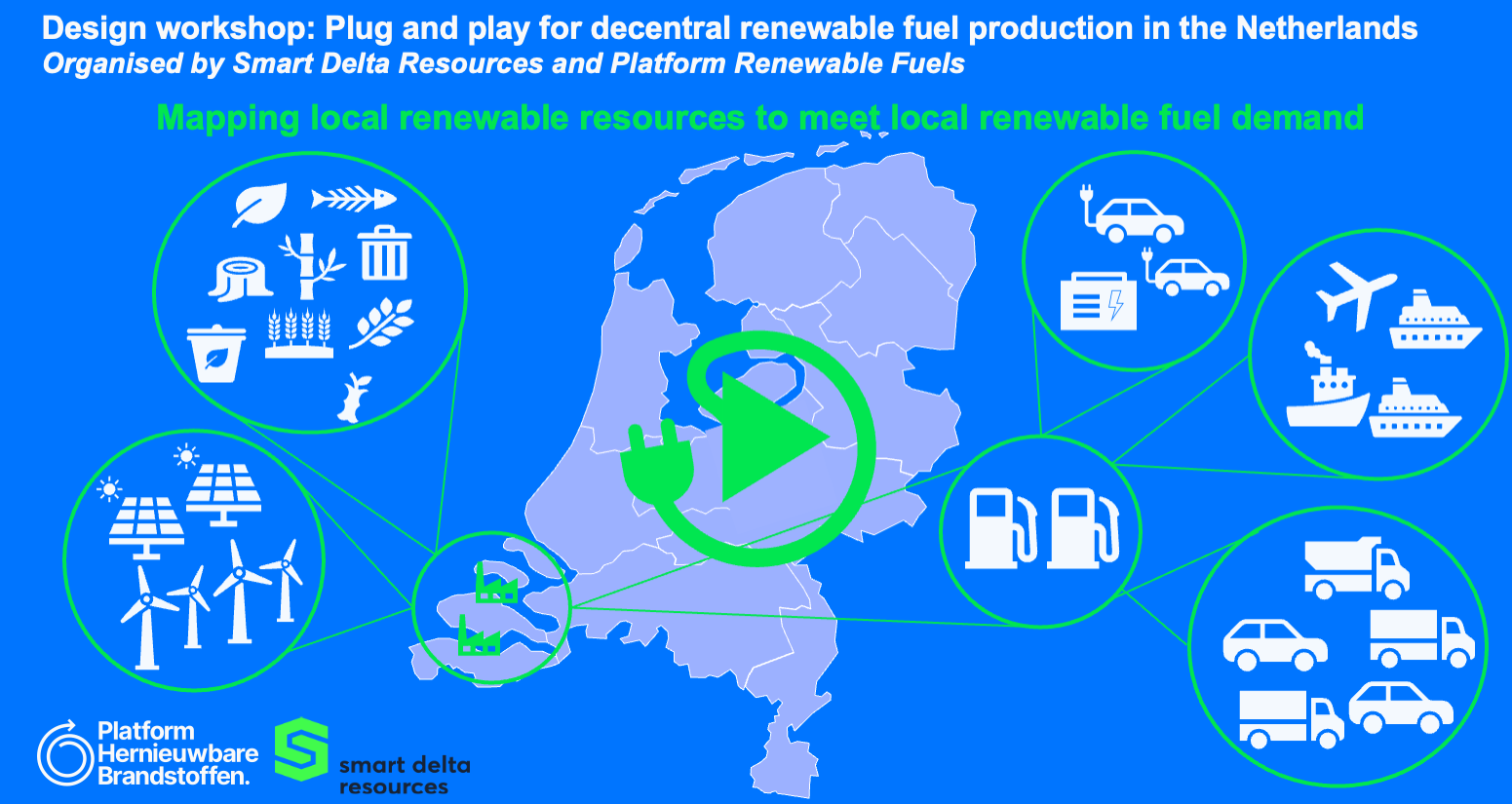
Platform Renewable Fuels in collaboration with Smart Delta Resources invite you to join our design workshop to develop the decentral renewable fuel production facilities to meet local demand. With the use of a ‘plug and play’ concept, we will assess the amount of renewable fuel product that can be delivered based on the availability of renewable energy and materials and the possible production pathways. We focus on the demand for shipping fuels (short sea, seagoing or inland shipping),aviation (regional airports) and road transport.
We first identify the local fuel demand needed for road transport, logistics parks, inland ships, seagoing shipping aviation or non-mobile road machinery. From there, we can sketch out the most suitable production pathway to match local needs and availability taking into account the local conditions and feedstock availability for instance biomass.
Join our design workshop to explore the renewable resources that can be made available in the region. This can be biomass wastes and residues, point sources of biogenic CO2 and renewable electricity (or green hydrogen)[1] or renewable feedstock import in port areas.
This plug and play concept takes into account availabilities and can optimise for instance either on efficiency of renewable electricity or biogenic carbon efficiency. Furthermore, we will look at which fuel concepts could help with providing flexible electricity for (fast)charging demand.
In the workshop, we will design a green production facility, calculate the required inputs (biomass, green hydrogen / renewable electricity) and fuel capacity that can be produced. This helps identify what part of the fuel demand can be met.
We are aware that technology platforms have synergies with building blocks needed for the chemical manufacturing industries. The workshop will focus on the transport mandates based on our knowledge of the transport mandates across road, shipping and aviation sectors.
The goal of the design workshop will be to map the potential volumes and how to provide at the right location, the right volume at the right time for demand in transport.
[1] circular carbon from plastics cannot be used for meeting transport mandates
