Retrospective on Lunch Seminar: Rethink strategic autonomy | December 15, 2025
Introduction
The Dutch Platform Renewable Fuels hosted a lunch seminar inviting a broader network of stakeholders to join the conversation to rethink renewable fuels for strategic autonomy. More than 40 people gathered in Amsterdam including government representatives, industry players, knowledge institutes and service providers. The seminar was moderated by science communicator Barry Fitzgerald.
In the current geopolitical landscape and ongoing polycrisis, strategic autonomy is becoming a high priority on the political agendas. At the same time, as electricity substitutes the demand for fossil fuels in road transport, we are noticing the impact on the refinery sector which finds it increasingly difficult to continue green production in Europe.
The current mandates are providing low demand instruments, not creating sufficient ambition and investment security to secure and build a production base in Europe. The aim of the seminar was to open the discussion to think about how we can continue renewable fuel production in Europe, considering the current European feedstock base and how to finance it.
Elements of a path forward were discussed over the course of the seminar centred around the need to keep current basic industries to produce in Europe, exploring decentralised solutions for energy production and provision on local levels along with discussions to unlock investments.
Programme
12:00 Start of programme moderated by Barry Fitzgerald
- Setting the scene - Loes Knotter (Platform Hernieuwbare Brandstoffen) - Download presentation
- Four bold ideas to keep industries in Europe - Professor Gert Jan Kramer (Sustainable Industry Lab) - Download presentation
- The demand for energy hubs for renewable fuels and electricity - Theo Heinink (Clean Energy Hubs programme) - Download presentation
- Decentralised systems to address grid congestion issues - Jan Pereboom (JP Energy Systems) - Download presentation
- Proposition from Ineratec and Rheinmetall for decentralised renewable fuel production for defence operations - Arthur Hustad (Ineratec) - See Giga PtX project
- Discussion on decentral vs central energy production with Arthur Hustad (Ineratec) and Ayla Uslu (TNO)
- Discussion and conclusions with John Grin, independent Chairman of Platform Hernieuwbare Brandstoffen and Professor at University of Amsterdam
You can download the summary of the event by clicking here or on the right hand side
Setting the scene – Loes Knotter, Platform Hernieuwbare Brandstoffen
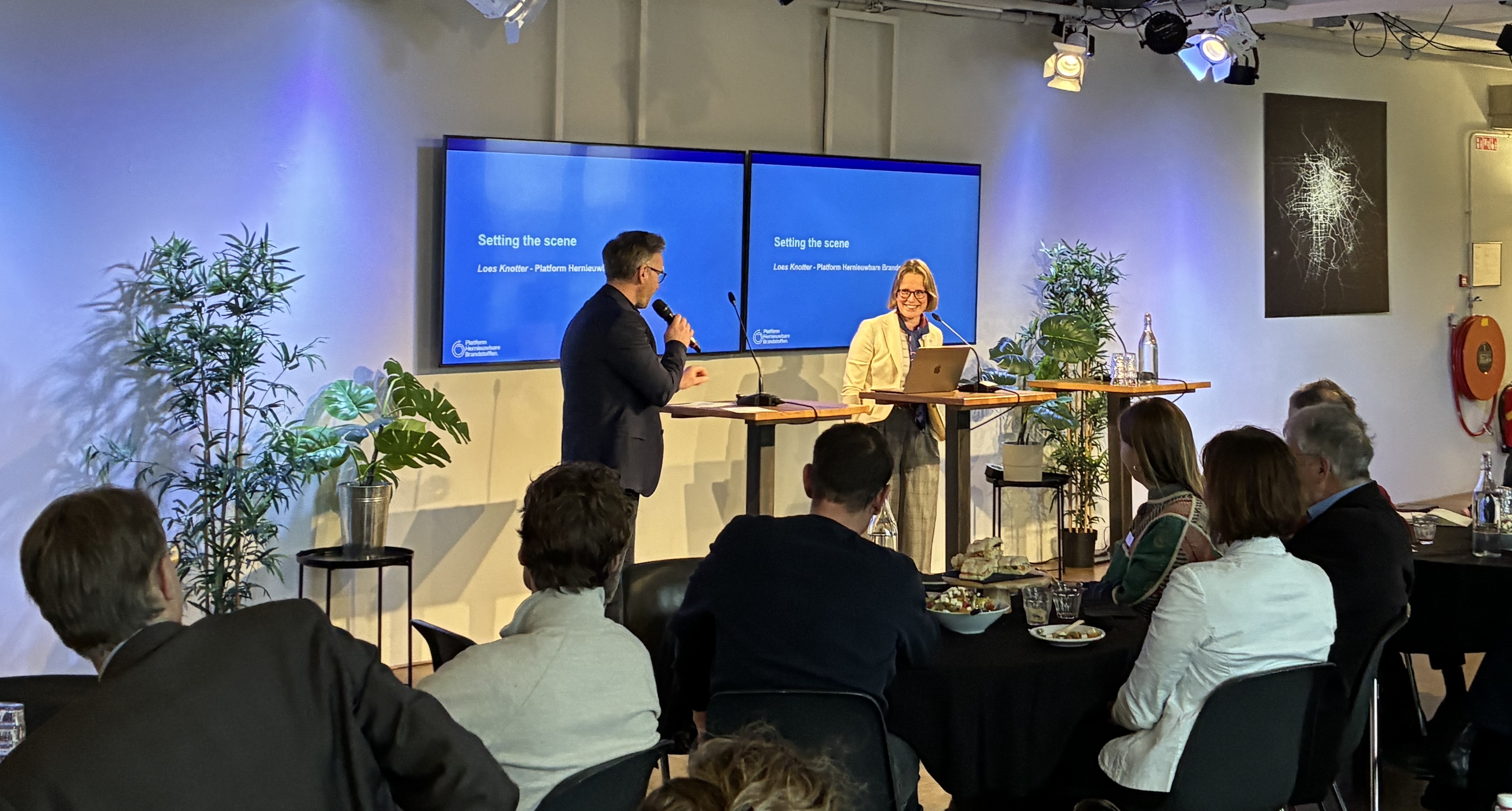
Loes Knotter, executive director of Platform Renewable Fuels, shared a retrospective of the activities of this year. She presented an overview of the analysis carried out for instance on renewable fuel volumes needed for seagoing shipping under FuelEU Maritime and ETS, regulations on the use of current gas infrastructure, and double-sided auction as an instrument to bridge supply and demand. The conclusion in relation to these projects is clear:
- Higher ambitions are needed to contribute to derisking investment
- We must make use of renewable fuels supply chains to build future perspective for chemistry
- Making good use of current infrastructure will help accelerate the deployment and ramp up of renewable fuels.
Moreover, she discussed the need to develop more a ecosystem approach to facilitate the energy transition where stable long-term policy, strong government leadership, market uptake and social acceptance must all be addressed in parallel.
From a strategic autonomy perspective, the Platform has carried out analysis demonstrating that the current instruments are not fit to secure and build production base in Europe. Nevertheless, renewable fuel production is considered a strategic capability by Dutch armed forces. We must think beyond market logic, pricing and level playing field to realise it. The main questions we aim to address during this semiar are:
- How to think about production in Europe? And also how to think about this from the perspective of self-reliance?
- How to match the European feedstock base: renewable electricity, biomass, with fuel production or basic chemical production?
- How to think about our options, about instruments and financial support?
Four bold ideas for an integrated transition strategyof the Dutch basic industry - Prof. Gert Jan Kramer, Sustainable Industry Lab
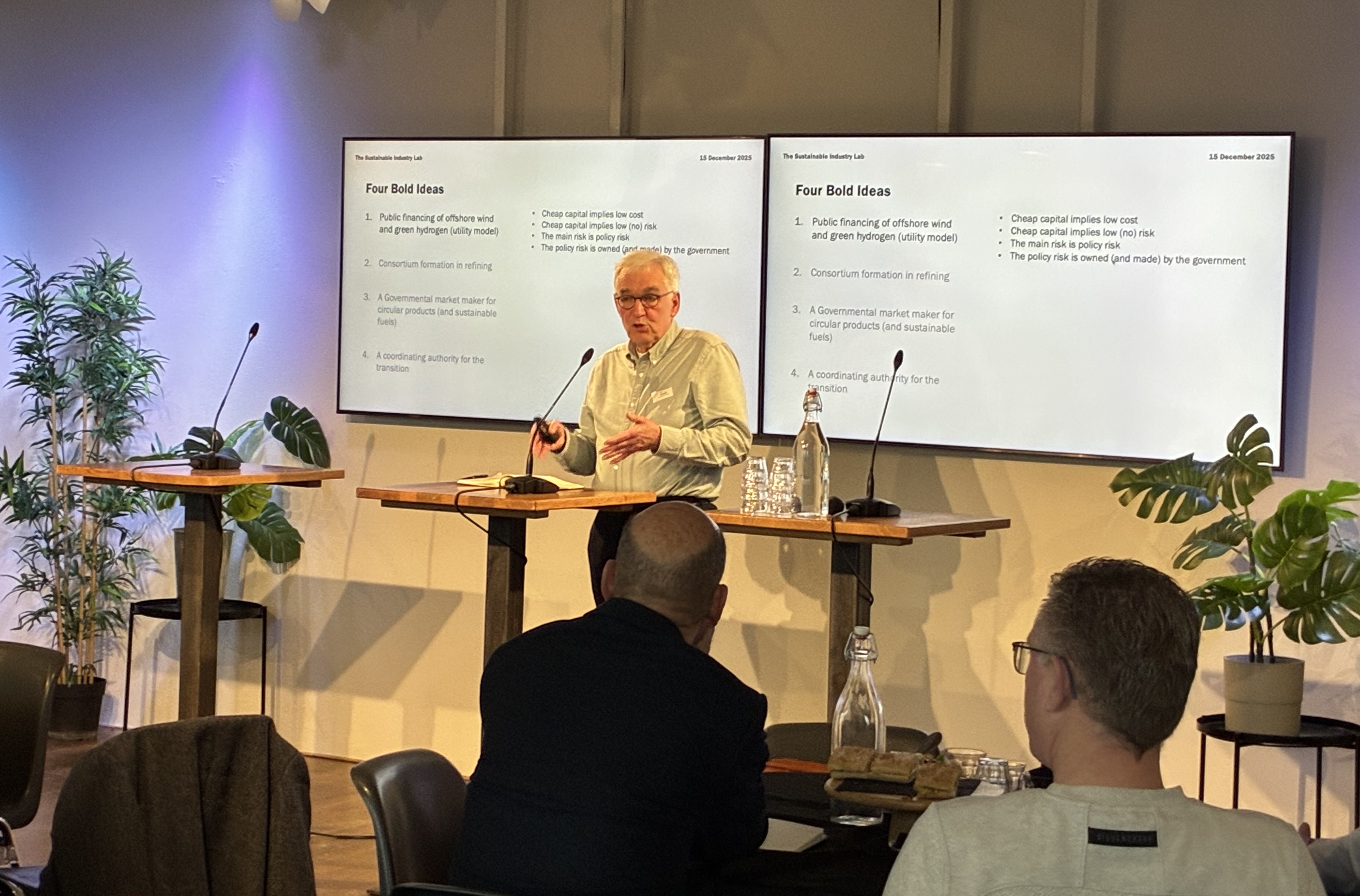
With the four bold ideas, Professor Gert Jan Kramer from the Sustainable Industry Lab presented on how to enable the Netherlands to contribute to European and global sustainable production. Professor Kramer affirmed the necessity for strong political leadership highlighting the need for the public and private sectors to come together to secure investments and help society accelerate the energy and material transition.
The four bold ideas provide a radical rethinking of how to envision the way forward with recommendations on how we consider change on a systemic level. The four ideas shared by Professor Kramer consist of
- public financing of offshore and green hydrogen
- Consortium formation in refining
- A governmental market maker for circular products and renewable fuels
- A coordinated authority for the transition.
Together these would allow to maximise our efforts and help industries in their transition.
The demand for energy hubs for renewable fuels and electricity - Theo Heinink, Clean Energy Hubs programme
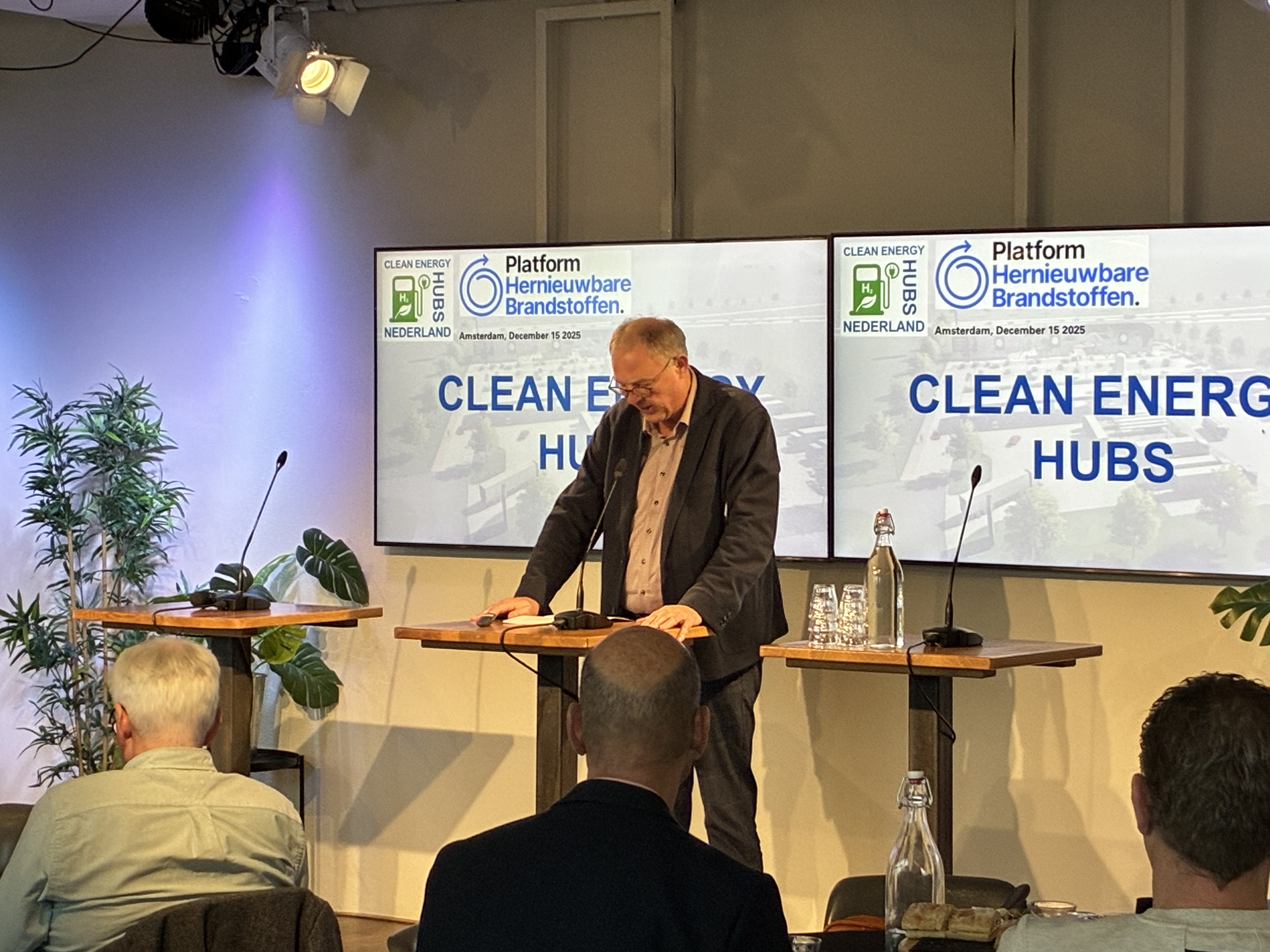
Theo Heinink from the Clean Energy Hubs programme discussed the programme’s ambition to deliver 100 clean energy hubs by 2030 together with all 12 Dutch provinces.The joint vision and strategy for these hubs is to develop a network for road transport and inland shipping with at least two renewable energy carriers offered per location. Clean energy hubs are facility centres for business or distribution parks which are envisioned to be tailored to the specific needs of the location and as such can be combined with various configurations. Theo promoted the need for joint research and knowledge sharing for these types of solutions which develop opportunities for more integrated thinking and working.
Decentralised systems to address grid congestion issues - Jan Pereboom, JP Energy Systems
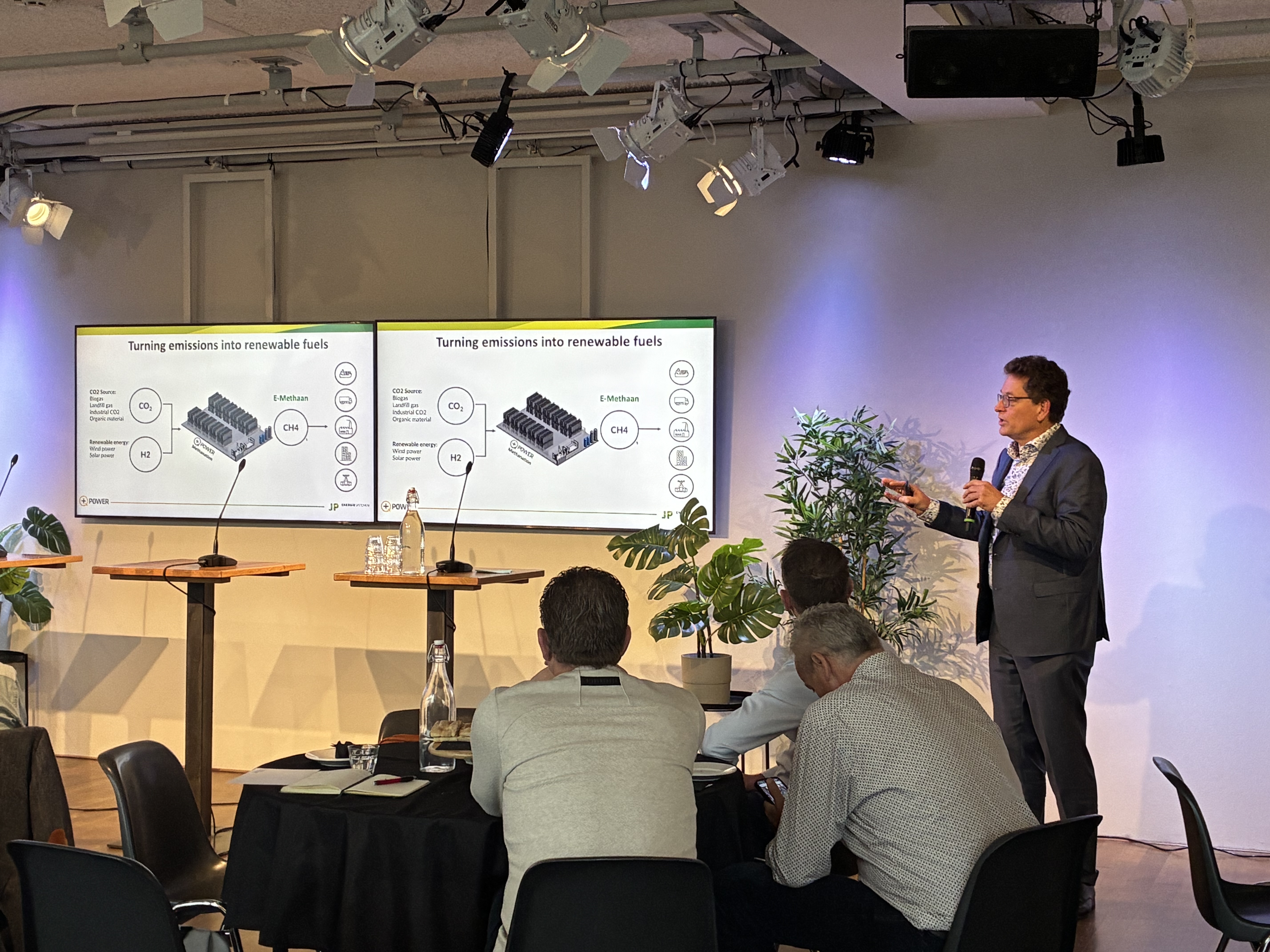
Jan Pereboom from JP Energy Systems delivered a pitch on their solution which can help address issues of grid congestion. E-methane is a synthetic fuel which combine green hydrogen from renewable electricity and CO2 from various sources that can be used in ships and heavy-duty vehicles. Alternatively, it can also be used as a storage option for surplus renewable electricity which can then be brought to areas that need it. He presented an ongoing project of a facility in Finland where a large electrolyser is operating and producing e-methane for mobility and other applications. Given the Dutch conditions and current gas infrastructure, e-methane is an interesting solution allowing the gas grid to become a long-term storage whichc an also enable the hydrogen route.
Proposition from Ineratec and Rheinmetall for decentralised renewable fuel production for defence operations - Arthur Hustad, Ineratec
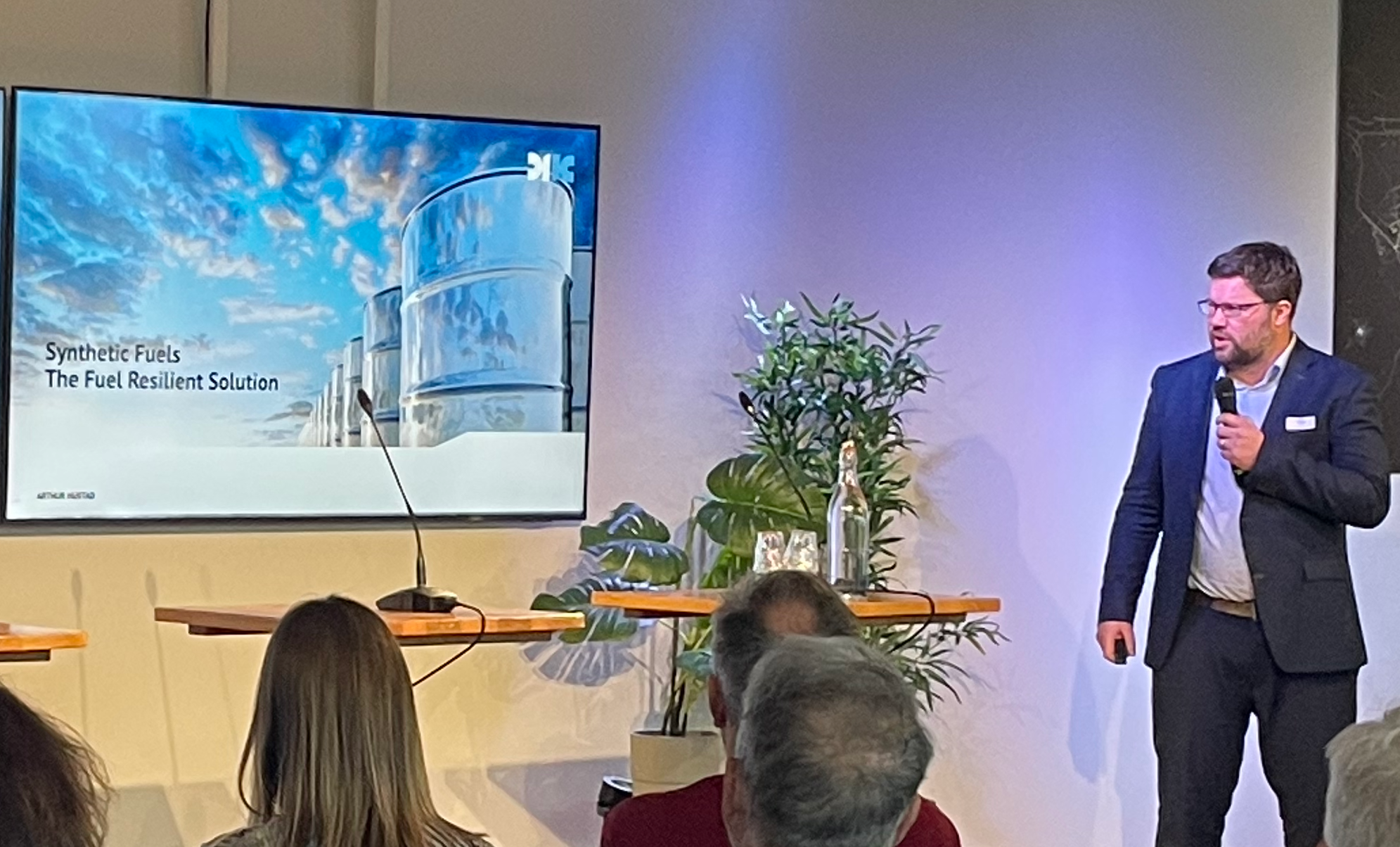
Following these two examples of decentralised energy production and supply to address local needs and issues, Arthur Hustad was invited on stage to present the proposition that Ineratec is developing to produce synthetic fuels together with Rheinmetall in Germany. This project,called Giga PtX, involves the development of decentralised and modular plants to to provide renewable fuels for defence operations. These plants combine the use of local resources including CO2 and renewable electricity and allow the military to produce renewable fuels independently. The project already has a facility in Frankfurt-Höchst, producing synthetic fuels which can be applied in aviation, shipping and road transport as well as synthetic base material for the chemical industry.
Arthur presented this specific example for the military, but this solution can also be broadened to larger societal need and applied to different context depending on the local feedstock availability and demand. He elaborated on several set-up scenarios where fuel production can be connected to current infrastructure, integrated onto industry, produced from local waste or fully remote. This technology provides a flexible solution for decentralised and small-scale production to serve local needs.
Discussion on decentral vs central energy production with Arthur Hustad, Ineratec and Ayla Uslu, TNO
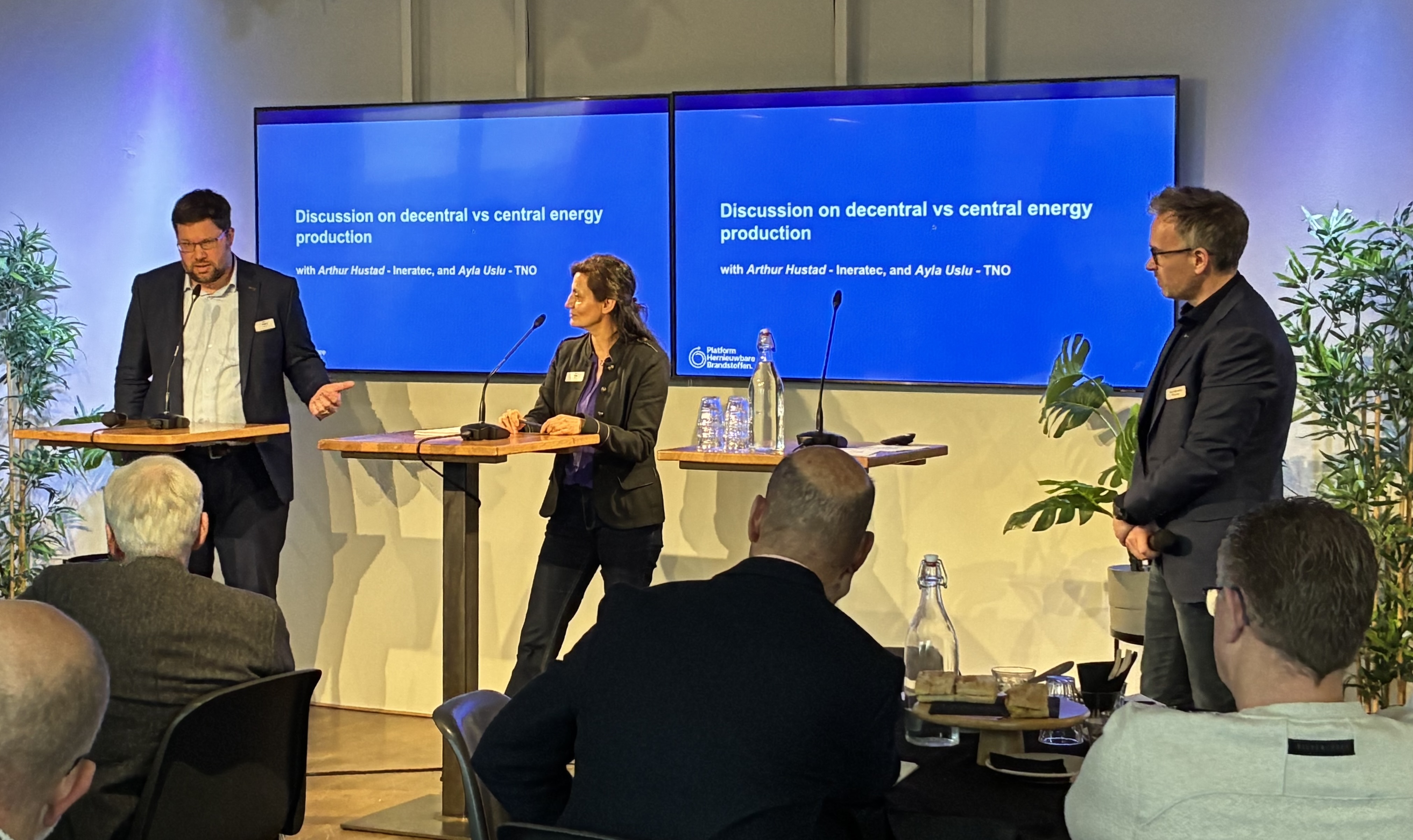
After Arthur Hustad’s presentation, Ayla Uslu, senior scientist at TNO, was invited on stage to share her views following from her ongoing work on financing advanced biofuel production in the Netherlands. Together, Arthur and Ayla discussed the need for biorefineries in the Netherlands as a critical strategic decision for strategic autonomy and reducing import. Given the Netherlands current petrochemical industry, grid congestion issues and feedstock availability, developing this local supply chains will help address these issues while also serving as a stepping stone for the chemical industry.
Arthur and Ayla agreed that it is not a matter of having either or decentralised or centralised production as both will be needed. Nevertheless, there is a need to repurpose the current assets by using current utilities while also promoting the development of new technology for advanced renewable fuel production. In terms of financial recommendations for these advanced biofuels, Ayla suggests the need to show case the value chain of lignocellulosic feedstock for advanced biofuel with first-of-a-kind commercial plant which will facilitate financing the scale up plants.
Discussion and conclusion with John Grin, Chairman of Platform Hernieuwbare Brandstoffen
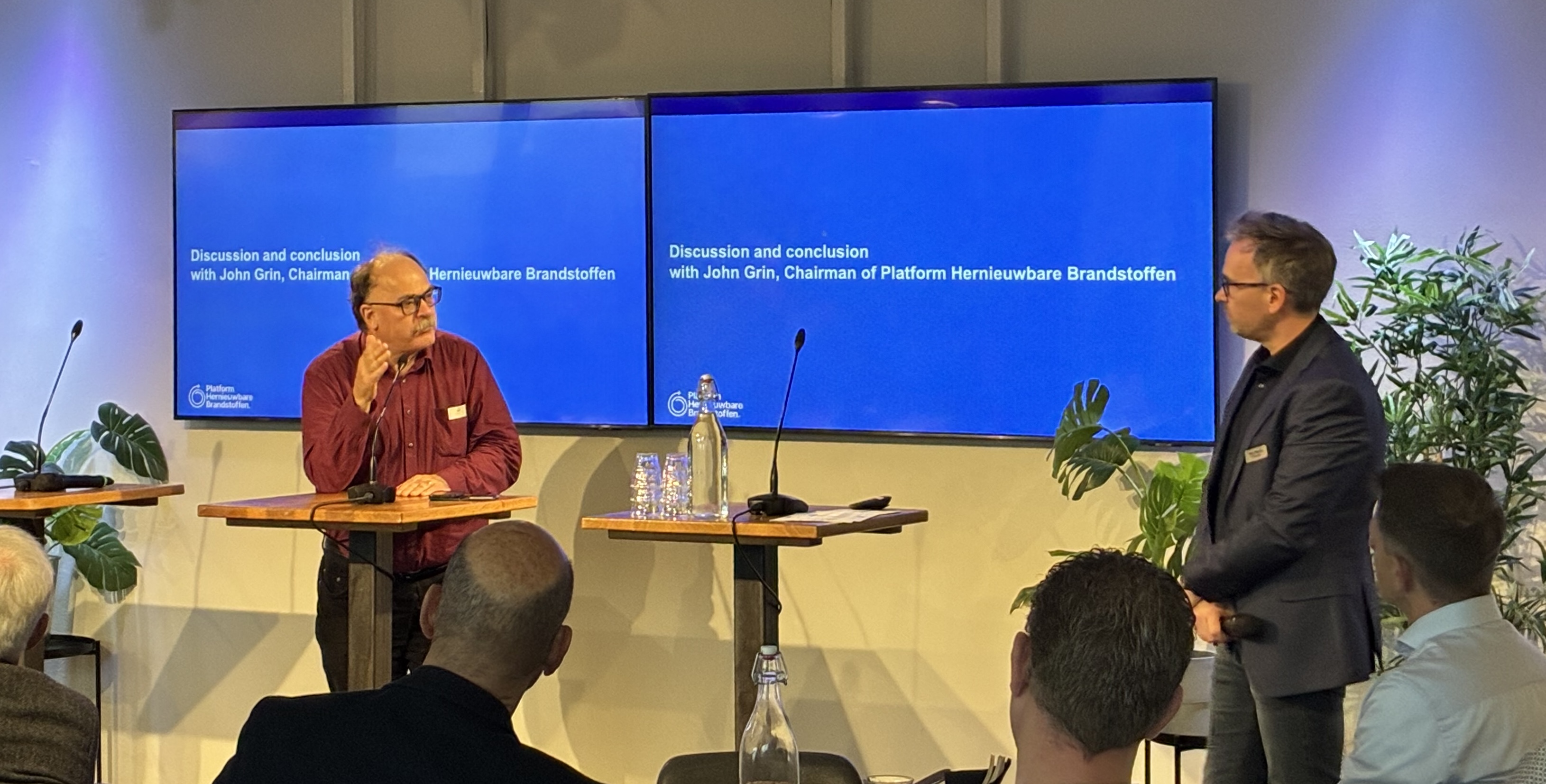
Lastly, Professor John Grin shared his concluding remarks on the centralised and decentralised production approaches and the way forward for strategic autonomy in Europe. He argued that to answer this, several questions must be further explored for instance on how we can organise more reliable feedstock collection either for decentral or central production, what are the necessary feedstocks that the industry needs and what are the different actors and locations that are willing and able to accelerate this transition. We will need to develop more expertise in these areas. In addition, looking at the incumbent industries which want to serve their own interest, how will it these coincide with a more decentralised strategy. Considering centralised option, we must also start envisioning the deals that can be made between government and industry especially if incumbents are reluctant to change. How can we ensure that industry will remain in the country? What is the role for government, incumbent industry and new parties?
The message is clear. Decentralised production is better for security and resilience. We must consider renewable fuels for our strategic autonomy and help accelerate the deployment by developing long terms policies and strong public and private partnerships. Renewable fuels are essential to achieve self-sufficiency, develop the supply chains needed for green chemistry and provide alternative to fossil energy in the face of climate change. What does this mean for collective action and what responsibility do each player wish to take for this mission?
Recente artikelen
CE Delft: Eerst de koers, dan de groei - Opties om de nationale klimaatdoelen voor de luchtvaart wettelijk vast te leggen | 2026
PHB: Analysis of the Dutch Fuel Transition Obligation - Market impacts and role of electricity in the ERE-system | 2026

DBFZ Resources Database