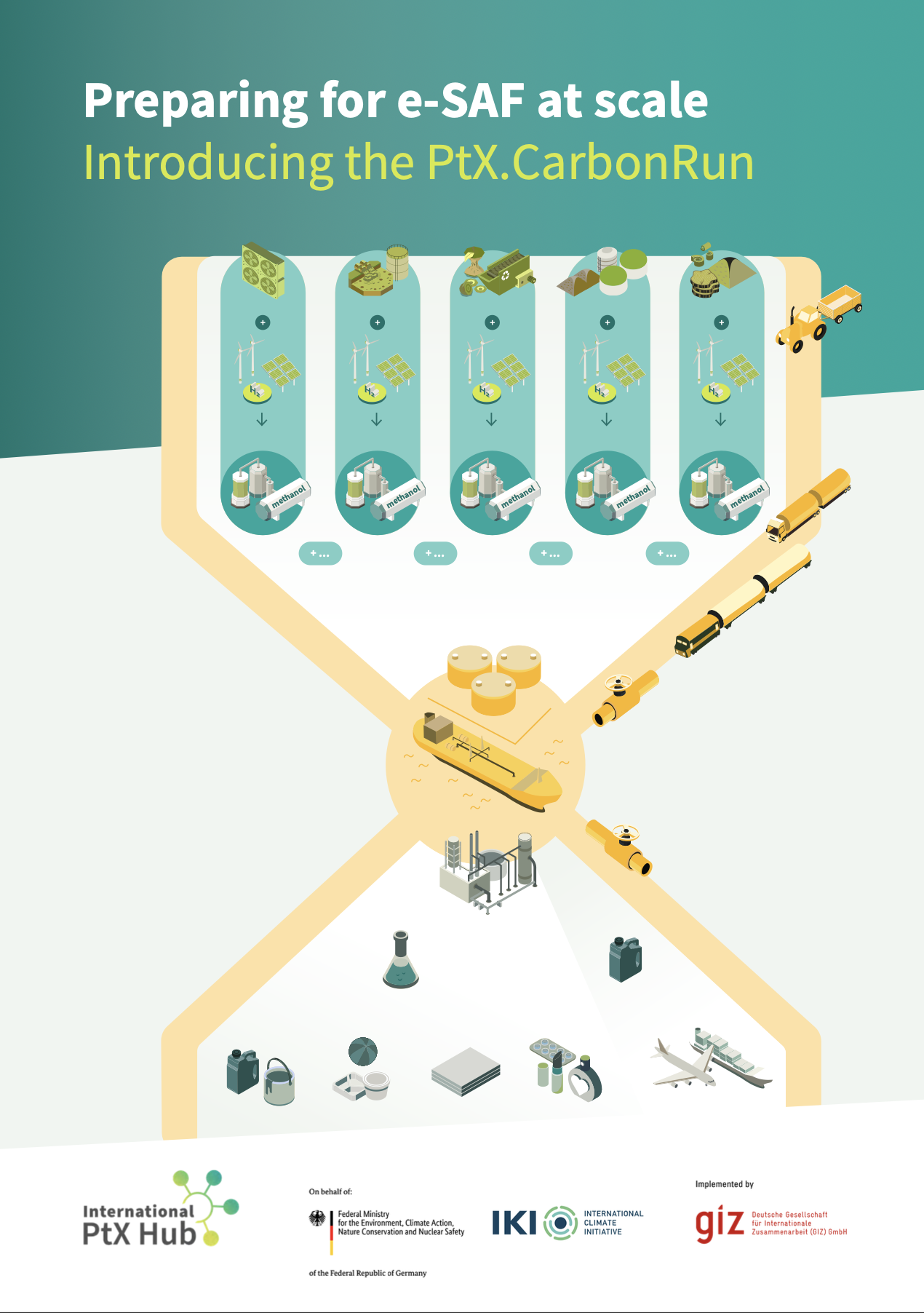
International PtX Hub: Preparing for e-SAF at scale | 2026
Executive summary
"The aviation sector has largely answered the question of whether Sustainable Aviation Fuels (SAF) are necessary with a strong yes. Battery-electric aircrafts are being tested for short- haul routes, and purely hydrogen-powered ones for both short- and medium-haul. But for long-haul operations and the long time to market for these alternatives, hydrocarbon fuels are crucial. The question is if their non-fossil versions can be scaled fast enough. Global aviation currently consumes more than 300 million tonnes of jet fuel annually, with demand rising, while SAF production currently only supplies less than one percent of demand. The challenge is no longer to prove that SAF works technically, but to build a system that builds new supply chains capable of replacing fossil aviation fuels at global scale. This impulse paper proposes the PtX.CarbonRun as a system to establish these new resilient supply chains. Rather than discussing the potentials of different fuel production technologies or feedstocks, the PtX.CarbonRun starts from a different observation: the future of sustainable aviation depends on mobilising vast quantities of renewable carbon from diversified and sustainable sources. Agricultural residues, forestry residues, biogas, sewage sludge, municipal waste, black liquor, other industrial biogenic carbon streams and, with sufficient economic viability, Direct Air Capture (DAC), i.e. carbon dioxide captured from the atmosphere, will all have a role to play. No single feedstock will be sufficient to satisfy the rising global demand for aviation fuels. Successful scaling of production therefore depends on creating a value chain capable of integrating many feedstocks into one common system.
The concept builds on three fundamental ideas:
First, the transition towards large-scale Power-to-Liquid (PtL) aviation fuels might not begin with billion-euro mega- projects. Biomass-to-Liquids (BtL) and Power-and-Biomass-to-Liquids (PBtL) production, using carbon from biogenic residues, can produce renewable fuels today at reasonable costs, while simultaneously creating the industrial capabilities required for future PtL deployment. Every project contributes fuel volumes, operational experience and expansion of supply chains, certification systems, logistics infrastructure and investment confidence. The real value of these projects therefore lies, beyond the produced SAF itself, in creating PtL readiness.
Second, the renewable carbon that is one key ingredient of all Sustainable Aviation Fuels must be transformed into a common, globally tradable intermediate product. The PtX.CarbonRun proposes methanol as the most suitable collection medium. Methanol is a liquid under ambient conditions, a globally traded commodity and a carrier of both renewable carbon and renewable energy. Unlike other intermediates, it can be produced economically at relatively small scale at the locations where the biogenic residues occur and then be transported efficiently using existing infrastructure. Methanol allows renewable carbon collection and final fuel production to be geographically separated, which is a game changer for both robustness and economics of sustainable aviation fuel production.
Third, with methanol as the intermediate product, aviation does not have to build these supply chains alone. Renewable methanol is already sought after by the chemical industry, the maritime sector and industrial applications. These off-takers can absorb significant methanol volumes long before Methanol-to-Jet facilities reach full-scale demand, creating early business cases, attracting investment and accelerating cost reductions and technology learning. Following ASTM‘s approval of methanol as a feedstock for Alcohol-to-Jet production in June 20261 , these new renewable methanol value chains can now directly supply future SAF production. Aviation becomes part of a much larger renewable carbon economy that serves other industries and maritime transport as well, rather than carrying the entire burden of scale-up of production on its own.
The PtX.CarbonRun creates a new setup of value chains. Renewable carbon and hydrogen are converted into methanol wherever resources are available. Methanol is then aggregated, transported and traded globally. Downstream, Methanol-to-Jet modules can be integrated into existing refineries, allowing SAF production to benefit from decades of industrial experience. Furthermore, in the form of methanol, both renewable carbon and renewable energy are imported to refineries. Therefore, unlike a hydrogen economy, this setup already contains all ingredients for downstream production and is easier to implement.
Because such a system involves thousands of producers, transfer points and transactions, trust becomes as important as the molecules themselves. The ecosystem to be built should therefore be digital-by-design. Every methanol batch is accompanied by a digital product passport containing quality parameters, sustainability attributes and logistics information. Chain-of-custody systems, Monitoring, Reporting and Verification (MRV) procedures and digital traceability ensure that sustainability claims, regulatory compliance and future book-and-claim systems can operate at industrial scale. At the same time, these data streams become a strategic asset in themselves, which enable future optimisation through artificial intelligence and advanced analytics.
Many of the technological capabilities, industrial experience and renewable carbon resources required to implement the PtX.CarbonRun already exist. However, these are distributed across countries, sectors and value chains, which have rarely been considered as part of one common system. The challenge lies in connecting these existing competencies to create the basic architecture for a non-fossil economy. Building such a system clearly requires technological innovation, industrial investment and supportive regulation. However, the process of defossilisation is not as far-fetched as one might think, especially if international cooperation based on trust, shared values and long- term partnerships is utilised to its full potential."
Recente artikelen
International PtX Hub: Preparing for e-SAF at scale | 2026
CE Delft: Eerst de koers, dan de groei - Opties om de nationale klimaatdoelen voor de luchtvaart wettelijk vast te leggen | 2026
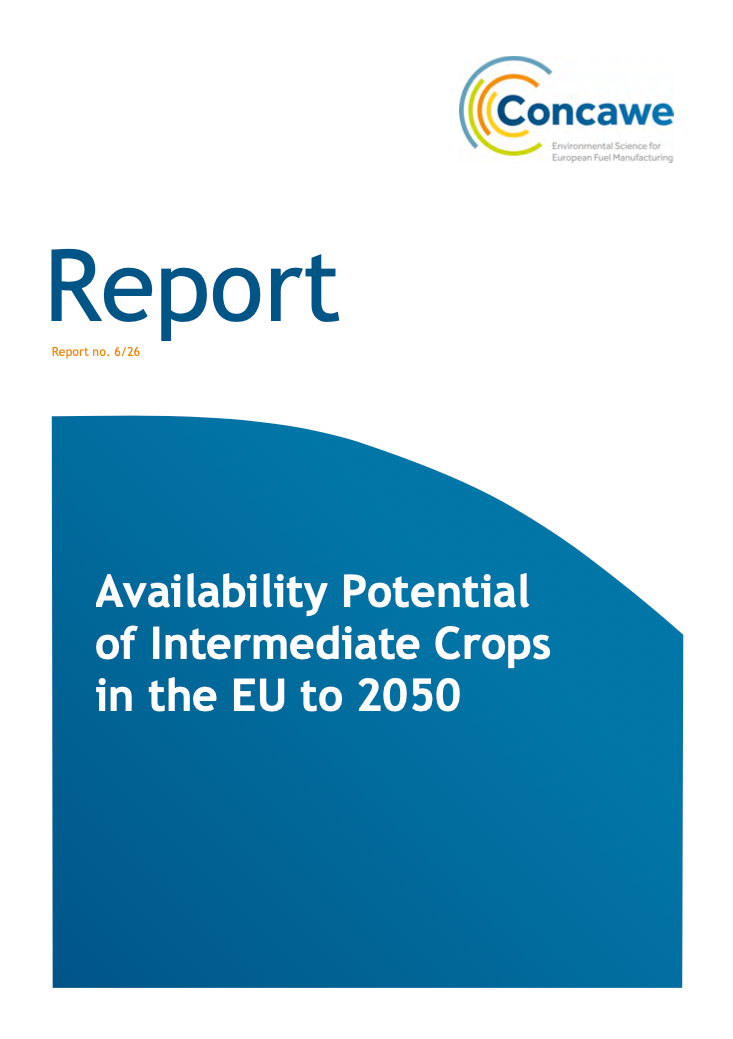
Concawe: Availability Potential of Intermediate Crops in the EU to 2050 | 2026